
Trees
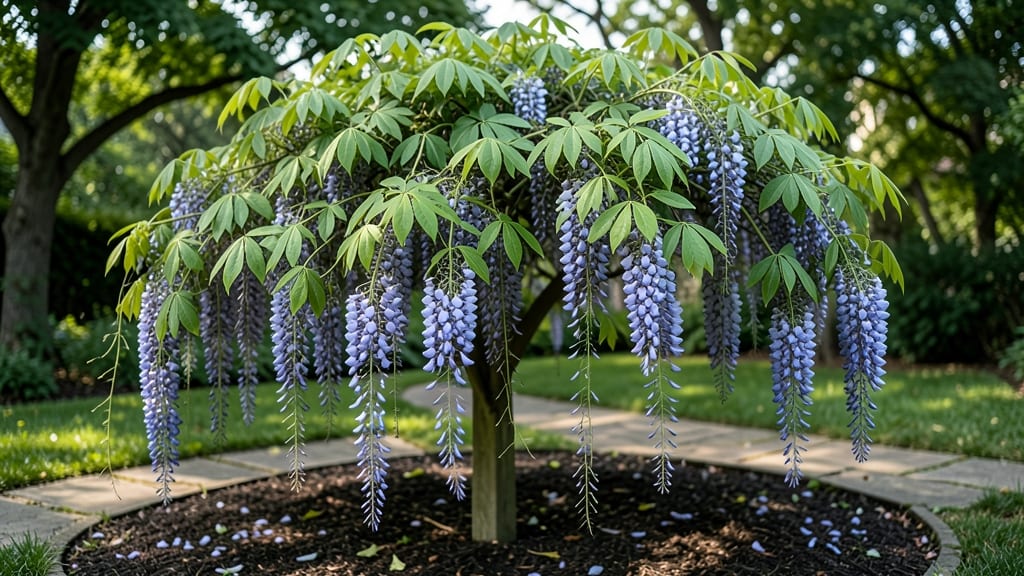
The Chinese Blue Weeping Wisteria tree thrives best in USDA hardiness zones 5 through 9, where it can withstand winter temperatures between -20°F and 30°F (-29°C to -1°C) for healthy growth and vibrant blooms. For zones 4 or 10, additional protection or shade adjustments are essential.
The Chinese Blue Weeping Wisteria's cold tolerance is tied directly to its native climate in China's temperate regions, where winters rarely drop below -20°F. This variety handles frost better than most wisterias because its thick bark and deep root system store moisture during dormancy. 🌿 In marginal zones, I recommend planting near south-facing walls or using windbreaks—these simple adjustments can push its limits by 2-3 zones.
For zone 4, consider wrapping the base with burlap in winter, while zone 10 plants benefit from afternoon shade during peak summer heat.
💡 In This Article
- Understanding Chinese Weeping Wisteria Cold Tolerance Limits
- Best Planting Zones and Microclimate Adjustments for Wisteria Success
Understanding chinese Weeping Wisteria cold tolerance limits
The Chinese Blue Weeping Wisteria's cold hardiness stems from its native adaptation to China's temperate climate, where winter temperatures typically range from -10°F to 25°F (-23°C to -4°C). This variety's thick, corky bark acts as a natural insulator, protecting the vascular system from freezing damage.
The bark's cellular structure contains air pockets that reduce heat loss, similar to how thermal insulation works in buildings. During dormancy, the tree's root system also plays a crucial role by storing carbohydrates and moisture, which sustains the plant through freezing conditions.
What sets this wisteria apart is its ability to trigger dormancy at specific temperature thresholds. Research shows that when nighttime temperatures consistently drop below 40°F (4°C) for several weeks, the tree enters a deep dormancy state.
This process hardens the plant's tissues by increasing sugar concentrations in cells, which acts as a natural antifreeze. Unlike American Wisteria varieties, which often struggle below -10°F (-23°C), the Chinese Blue Weeping Wisteria can survive -20°F (-29°C) thanks to these physiological adaptations.
The flowering cycle also benefits from this hardiness—the tree's buds form in late summer and remain protected through winter, ready to burst into bloom as temperatures rise in spring.
However, the tree's cold tolerance isn't absolute. Prolonged exposure to temperatures below -20°F (-29°C) can cause dieback, particularly in younger plants with thinner bark. This is why zone 4 gardeners often see stunted growth or delayed flowering—the plant is constantly fighting to recover from winter stress.
The root system, while deep, can also suffer if the ground freezes solid for extended periods, cutting off essential moisture and nutrient uptake. This explains why even in zone 5, some gardeners report better success when planting near south-facing walls or using windbreaks to create microclimates that moderate extreme temperatures.
Comparing this variety to other wisterias reveals another advantage: its ability to handle rapid temperature fluctuations. While many wisterias struggle with sudden cold snaps after warm spells (a phenomenon called "late-winter warming"), the Chinese Blue Weeping Wisteria's bark and root system provide more stability.
This resilience makes it a better choice for gardens in transitional zones where weather patterns can be unpredictable.
For example, in zone 6, where winter temperatures might dip to -10°F (-23°C) but occasionally drop further, this wisteria often recovers better than its American counterparts, which may experience complete dieback under similar conditions.
One fascinating aspect of this tree's cold tolerance is how it affects its growth rate. In optimal zones (5-9), the tree grows about 12-24 inches per year, but in marginal zones, growth may slow to just 6-12 inches annually as energy is diverted toward survival rather than expansion.
This slower growth doesn't necessarily mean the tree is unhealthy—it's simply prioritizing root development and bark thickening to better withstand future cold snaps.
Gardeners in zone 4 often report that while the tree may take longer to establish, once it reaches maturity (around 5-7 years), it becomes remarkably resilient, with some specimens living for decades despite harsh winters.
The tree's ability to handle cold also extends to its flowering performance. In ideal zones, the Chinese Blue Weeping Wisteria produces abundant blooms in late spring, with each vine capable of bearing hundreds of flowers.
However, in marginal zones, the plant may delay flowering or produce fewer blooms as it conserves energy.
This is why gardeners in zone 10 sometimes struggle—the tree may focus more on shade tolerance and heat resistance than on flowering, especially during hot summers where temperatures can exceed 90°F (32°C) for extended periods.
Understanding this trade-off helps explain why some gardeners in less-than-ideal zones choose to grow this variety for its foliage and structural beauty rather than its flowers.