
Trees
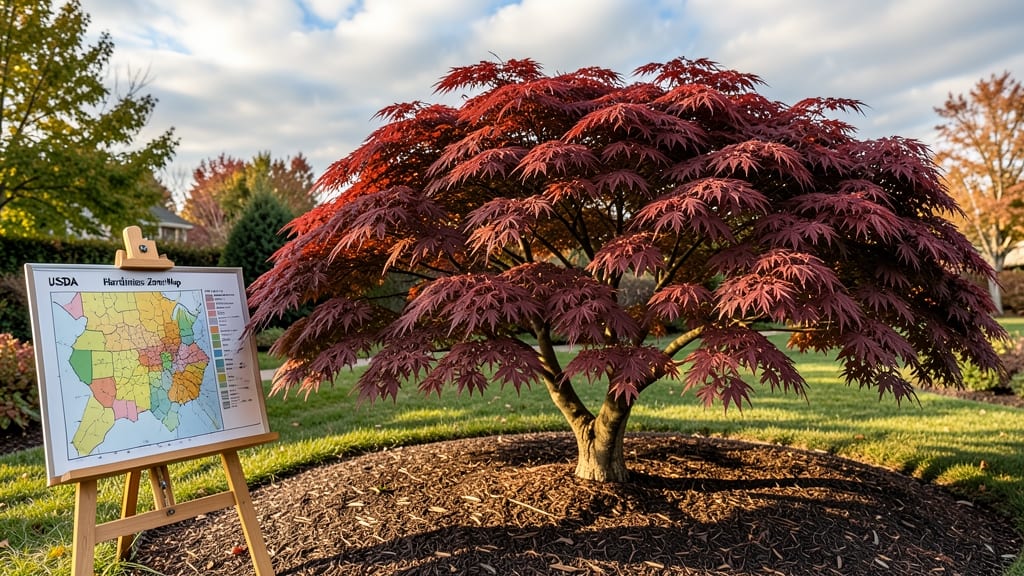
Japanese maple trees thrive best in USDA hardiness zones 5 through 8, though cold-hardy varieties like Acer palmatum 'Bloodgood' can survive in zone 4 with proper winter protection. Local climate factors like soil drainage and afternoon shade significantly affect their winter resilience.
Japanese maples are prized for their stunning foliage, but their cold tolerance varies dramatically by variety. 🌳 Most standard types struggle below zone 5, where winter temperatures can drop to -20°F, while the 'Bloodgood' cultivar can handle -30°F with winter wraps or mulch.
What sets these trees apart is their ability to enter dormancy—when temperatures consistently stay below 40°F for several weeks, they shut down metabolic processes to survive frost. This adaptability makes them more resilient than many assume, especially when paired with strategic planting in sheltered microclimates.
For gardeners in marginal zones, the key is creating protective conditions. A south-facing wall or evergreen windbreak can raise microclimates by 5-10°F, while thick mulch layers prevent soil freeze-thaw cycles that damage roots.
Container-grown specimens offer additional flexibility, allowing you to move them to protected areas during harsh winters. The trade-off? Container trees need consistent moisture and may require larger pots as they mature.
💡 In This Article
- USDA Zones 5-8: Japanese Maple Cold Tolerance Explained
- Microclimate Hacks for Growing Japanese Maples Outside Ideal Zones
USDA zones 5-8: Japanese maple cold tolerance explained
The core reason Japanese maples excel in zones 5-8 lies in their dormancy mechanism—a biological adaptation that shuts down metabolic activity when temperatures drop below 40°F. During dormancy, their cells produce antifreeze proteins that prevent ice crystal formation in tissues, similar to how some fish survive Arctic winters.
This process begins when daylight shortens in autumn, triggering hormonal changes that harden leaves and stems. 🌡️ Most varieties can tolerate brief dips to -10°F, but prolonged exposure to -20°F (zone 5's coldest extremes) often causes bark splitting or dieback.
Varieties like 'Bloodgood' push limits further by developing thicker bark and deeper root systems that insulate against cold. Studies show these cultivars can survive -30°F when planted in well-drained soil, as their roots stay 5-10°F warmer than air temperatures due to soil mass.
The trade-off? Their growth slows dramatically in zone 4—expect 30-50% slower annual height increases compared to zone 6 counterparts. This explains why some gardeners report 'Bloodgood' trees thriving in zone 4 with winter wraps, while standard types like 'Shishigashira' fail.
Acclimatization plays a hidden role too. Trees planted in cooler zones within their range (e.g., zone 5's upper limit) develop stronger cold resistance over time. This is why nursery-grown saplings from zone 6 may struggle in zone 5's first winter, while established local specimens often survive.
The key threshold? Three consecutive winters of gradual cold exposure typically hardens a tree sufficiently. 🌱 For new plantings, start with container-grown specimens—they've already undergone this natural hardening process.
What most people overlook is how soil temperature affects survival. Japanese maples' roots are far more sensitive than their canopies—soil temps below 25°F can kill roots even if air temps stay above freezing.
This is why mulching with 4-6 inches of organic matter (like wood chips) is critical: it maintains soil temps 10°F warmer than ambient air. In zone 5, this difference can mean the difference between survival and root rot from freeze-thaw cycles.
Here's the science behind zone 4 exceptions: Cold-hardy varieties like 'Bloodgood' produce more abscisic acid during dormancy, a hormone that enhances cold tolerance. This chemical boosts their ability to recover from winter damage—something standard types lack.
The result? While both may show leaf scorch after -25°F exposure, 'Bloodgood' often regrows foliage from dormant buds, whereas others may take 2-3 years to recover. 🍂
For gardeners pushing boundaries, consider these temperature rules of thumb: Zone 5 (-20°F): Standard types with winter protection; Zone 4 (-30°F): Only cold-hardy cultivars with mulch/wraps; Zone 9+ (20°F): Varieties need afternoon shade to prevent heat stress.
The sweet spot? Zones 6-7 where most Japanese maples hit their growth prime with minimal intervention.