
How To
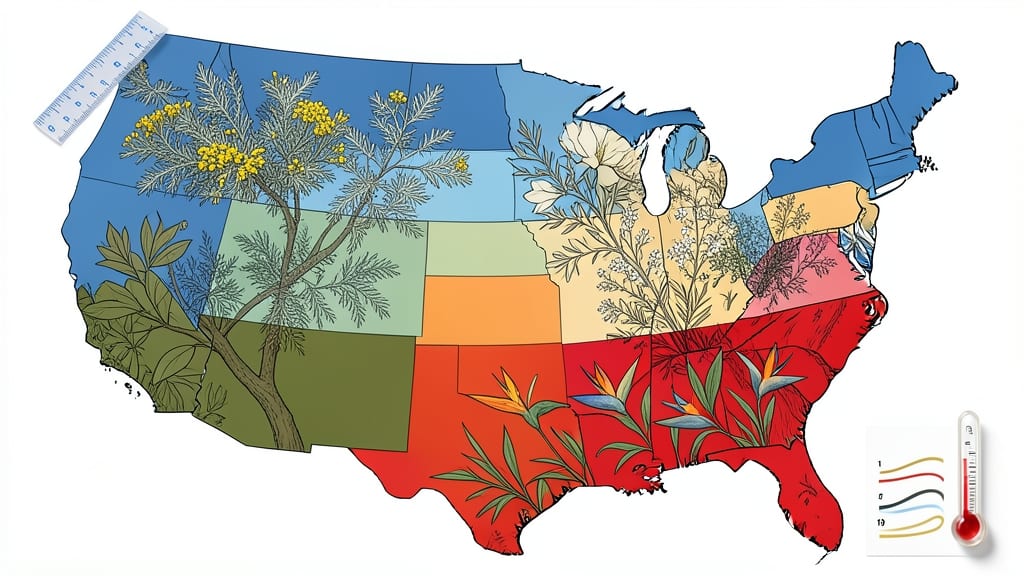
A map of US planting zones helps you identify your specific growing region (zones 1-13) based on average winter lows, which directly impacts what plants will survive in your area. Use the USDA interactive map to locate your zone by ZIP code, then select plants suited to your zone's frost patterns and seasonal conditions.
The USDA divides the country into 13 distinct planting zones, each representing a 10°F temperature range.
For example, zone 5 (common in the Midwest) averages between -20°F and -10°F, while zone 10 (Florida/Hawaii) stays above 30°F. 🌱 These zones aren't just about cold tolerance—they also predict your last spring frost and first fall frost dates, which are critical for timing plantings.
I always recommend checking the USDA's interactive map by entering your ZIP code, as it provides the most precise zone information for your exact location.
What's particularly useful is how the map accounts for microclimates—small areas with unique conditions. A backyard in a city might be zone 6, but a nearby hillside could be zone 5 due to colder air settling.
For container gardening, you can sometimes push zone limits by moving pots indoors during cold snaps, but this requires careful monitoring of nighttime temperatures.
💡 In This Article
- How US Planting Zones Affect Plant Survival
- Finding Your Planting Zone: Step-by-Step Guide
How US planting zones affect plant survival
The USDA's planting zone system is based on the average annual minimum temperature recorded over a 30-year period, with each zone representing a 10°F range. This temperature threshold is critical because it determines whether a plant's cells will freeze and rupture during dormancy.
For example, a zone 4 plant (avg. -30°F to -20°F) can survive winters in Minnesota but would perish in zone 8 (avg. 10°F to 20°F) without protection.
The science lies in how plant tissues respond to cold - as temperatures drop below a species' hardiness threshold, cellular water freezes, causing ice crystals to form and damage cell walls.
Frost dates are another key factor tied to zones. The USDA uses historical data to predict your last spring frost and first fall frost, which typically occur 2-4 weeks earlier in higher-numbered zones.
In zone 7, for instance, gardeners can plant warm-season crops like tomatoes 2 weeks earlier than in zone 5 because the soil warms faster. This timing difference is why zone 7 gardeners enjoy a 140-160 day growing season while zone 5 gardeners only get 100-120 days.
The transition between zones also creates "frost-free" periods that directly impact what you can grow annually.
Microclimates add complexity to zone-based planning. A south-facing wall can create a zone 8 microclimate in an otherwise zone 6 area, allowing you to grow plants one zone harder than your official designation.
Similarly, urban areas often experience heat island effects, where pavement and buildings raise temperatures 5-10°F higher than surrounding rural zones.
For container gardening, this means you might safely grow zone 9 plants in pots that you could bring indoors during cold snaps, effectively extending your growing range by 1-2 zones.
Elevation plays a surprising role too. Every 1,000 feet of elevation gain roughly equals 3.5°F cooler temperatures. That means a mountainous area in zone 6 might have microclimates as cold as zone 4 at higher elevations, while valleys could reach zone 7.
This is why the USDA map shows irregular boundaries - it accounts for these topographical variations. For gardeners in transitional zones (like zone 6b/7a), this means carefully selecting plants that match the coldest microclimate in your yard rather than relying solely on your official zone number.
Dormancy cycles are the biological mechanism that ties zones to plant survival. Most perennials enter dormancy when nighttime temperatures consistently drop below 40°F, and they won't break dormancy until they've experienced sufficient chilling hours (typically 500-1,500 hours below 45°F).
This is why zone 9 plants struggle in zone 5 - they don't get enough cold exposure to properly reset their growth cycles. The zone system essentially maps these biological requirements to geographic locations, helping you match plants to their natural temperature ranges.
What most gardeners overlook is how zone boundaries reflect probability rather than absolute guarantees. The USDA map shows 10-year averages, meaning there's a 10% chance in any given year that your zone 7 area might experience a -15°F winter night (zone 6 conditions).
This statistical reality is why experienced gardeners in marginal zones often use mulch, row covers, or cold frames to create localized microclimates that protect tender plants during rare cold snaps. Understanding this probability helps you make informed decisions about which plants to push beyond your official zone limits.